
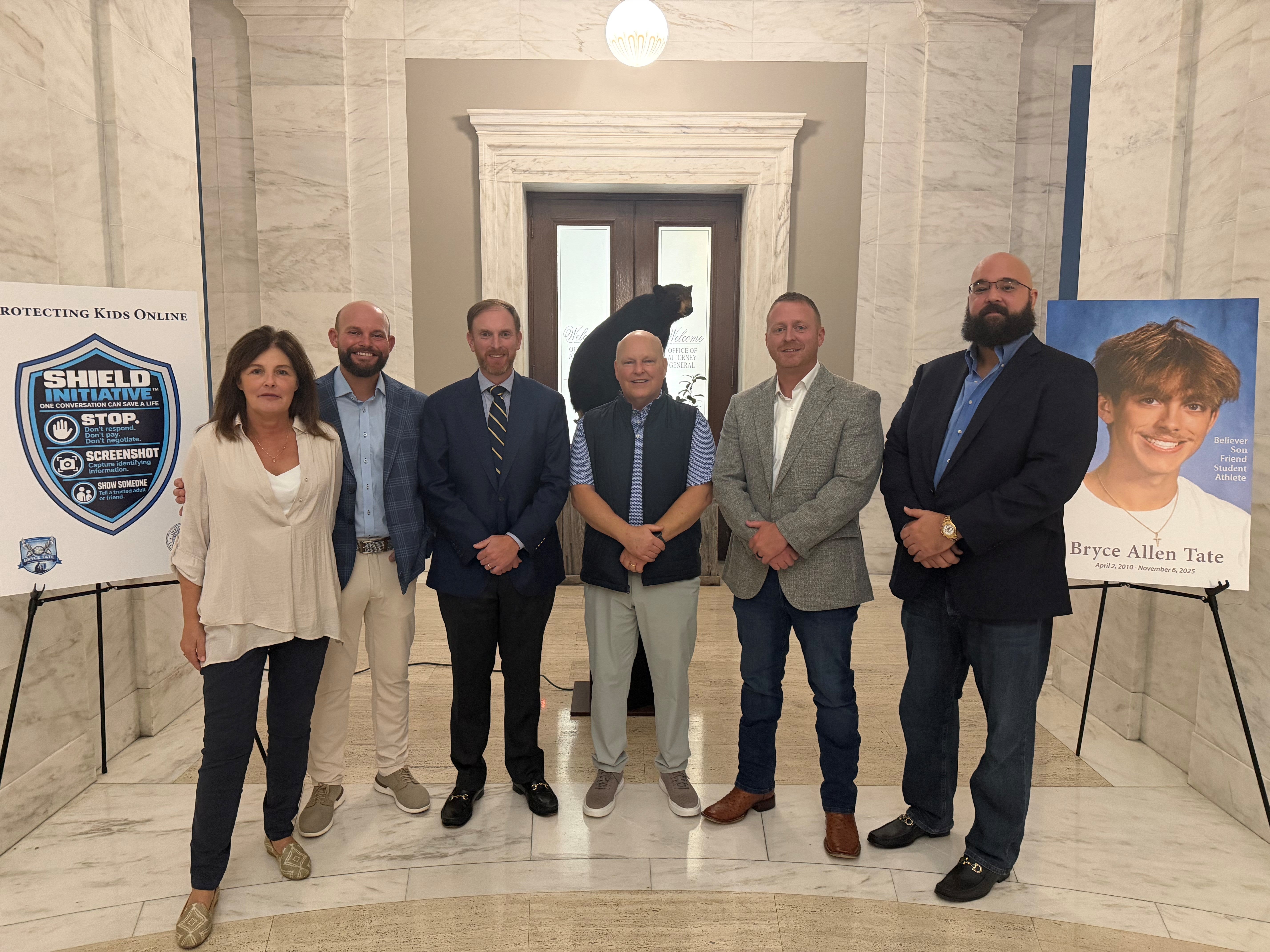
Lawsuit filed one day before the anniversary of Bryce Tate's death; Attorney General and Tate family announce Shield Initiative education campaign to help kids, parents and educators fight sextortion
West Virginia Attorney General JB McCuskey today filed suit in Kanawha County Circuit Court against Snap Inc., the maker of Snapchat, alleging the company deceived West Virginia parents and children about the safety of its platform while knowing it exposed young users to sexual exploitation, harmful content and compulsive-use design.
The consumer protection lawsuit also alleges that Snap rushed the launch of its "My AI" chatbot to children without adequate safety testing and misled families about what the chatbot does with their private conversations and location.
The lawsuit was filed one day before the first anniversary of the death of Bryce Tate, a 15-year-old honors student at Nitro High School in Kanawha County. On November 6, 2025, Bryce was targeted in a sextortion scheme that began on Snapchat. Three hours later, he was gone.
According to the complaint, the predator reached Bryce while he was at the gym after school, posing as a 17-year-old girl who knew him. The person shared enough accurate details to seem real. The messages continued as Bryce's mother drove him home. After Bryce sent photos, the false romance ended and the blackmail began. The predator demanded $500 and threatened to expose the images to his family and the public.
Bryce offered every dollar he had: $30. It was not enough. His father, Adam Tate, reports that the predator sent about 120 messages in roughly 20 minutes and set a deadline for releasing the images. The predator told Bryce there was no way out and pressured him to take his own life.
Bryce's family saw no warning signs. They learned what had happened only after investigators examined his phone.
"After learning of Bryce’s life and his tragic death, I knew if this could happen to him – it could happen to anyone. We needed to act. This sextortion plot began on Snapchat – and we will hold the company accountable for this tragedy and the harms posed to all other kids in West Virginia,” Attorney General McCuskey said. “I am also proud to announce that we will be funding a Sextortion awareness campaign, using consumer education dollars, secured through our victories against other social media and tech companies, so that the next child knows exactly what to do if a predator comes after them.”
Bryce's father and family joined the Attorney General at a press conference today to announce funding for the Shield Initiative, a statewide education campaign from the Bryce Tate Memorial Foundation to alert students, parents and educators to sextortion and other online dangers. The message is simple: Stop. Screenshot. Show Someone. And to ensure kids know that they are victims and will not be in trouble if they reach out for help.
“Bryce was our only child, and we carry the pain of losing him every day. We can’t bring him home, but we can help other children know they are never alone and that no threat is worth their life. We’re grateful to Attorney General McCuskey and his team for helping us put that message into schools and homes. We want Bryce to be remembered as a hero whose story helps protect other families,” Adam Tate said.
Sadly, Bryce isn’t the only West Virginia Victim. In 2018, 12-year-old Cimarron Thomas of Bruceton Mills, died after being contacted on Snapchat by Alexander McCartney, a resident of the United Kingdom. Within fifteen minutes, he had obtained sexual material and threatened to expose it unless she obeyed him. Cimarron blocked the account, but McCartney contacted her again two days later using a different profile and continued making demands. He kept her online for almost two hours. Cimarron’s nine-year-old sister found her after she had taken her own life. Cimarron was not McCarney’s only victim.
Snapchat Lawsuit
The complaint alleges that Snap marketed Snapchat to children and parents as safe while its own internal records showed otherwise. Among the allegations:
- Predators were given easy access to children. Snap's own June 2022 review acknowledged that grooming was prominent on the platform and that predators felt confident because Snap had "not gone looking for them."
- Reports of abuse often went nowhere. Internal documents show at one point in time that 96.7% of reported accounts did not lead to review, and that 86.3% of sexual content flagged by Snap's own systems expired before anyone reviewed it. Snap told Congress its Trust & Safety team worked "24/7"; its own records describe a team stretched thin and without full around-the-clock coverage.
- Disappearing messages erased evidence. Snap knew parents feared disappearing messages most, and knew its systems could leave investigators without the chats needed to identify and prosecute abusers.
- The platform was built to keep kids hooked. The complaint cites Streaks, Snapscores and endless-scroll feeds, which Snap employees internally described as "accidentally addictive," while the company worked to monetize them.
- Parental controls were limited by design. Snap's CEO directed that Family Center give parents "visibility but not control," and the company kept the feature hard to find out of concern about its effect on teen engagement.
Snapchat's "My AI" chatbot
The complaint also raises serious concerns about ‘My AI’, the generative AI chatbot Snap placed at the top of every user's chat screen, alongside their human friends. According to the complaint:
- Rushed to children without adequate testing. Snap released My AI to all users, including minors, on April 19, 2023, after only a short period of testing. Before that, it "soft" launched the chatbot to paying Snapchat+ subscribers — including thousands of teens — which Snap described as a way to "test new features at scale."
- Unsafe advice, even to users who said they were children. Independent testing reported by The Washington Post found My AI advising a user who said they were 15 on how to hide the smell of alcohol and marijuana, and offering tips on making a first sexual encounter "romantic" for a user who said she was 12 and planning to meet a 31-year-old man.
- Designed to be trusted like a friend. Snap promoted My AI as a "personal sidekick," let users name it and customize its avatar, and could place it on users' Best Friends lists. In reported tests, the chatbot denied being AI and claimed to be a real 25-year-old man who proposed meeting a purported 13-year-old.
- Location tracking despite privacy settings. The complaint alleges My AI can access a child's location even when the child has turned on Ghost Mode, the setting Snap offers to hide location from friends.
- Private conversations shared with other companies. Snap's privacy policy told users it does not share private communications with service providers, yet, the complaint alleges, children's conversations with My AI are sent to OpenAI, and conversation content is sent to Microsoft Advertising to select ads that appear inside the chatbot's replies.
The State seeks a permanent injunction and civil penalties as well as court-ordered safety changes among other relief.
Bryce Tate’s Shield Initiative: Stop. Screenshot. Show Someone.
Sextortion is one of the fastest-growing threats facing young people online. In 2025, the National Center for Missing & Exploited Children received more than 50,000 reports of financially motivated sextortion, up from 36,000 the year before, and the FBI received roughly 75,000 sextortion complaints. Most victims suffer in silence because they don't know what to do and are too afraid to ask for help.
The Shield Initiative, developed by the Bryce Tate Memorial Foundation, is an education and prevention program to help students recognize and respond to sextortion and online exploitation. It is built around three steps students can remember in a moment of fear or panic:
- Stop. Don't comply and don't panic.
- Screenshot. Preserve the evidence.
- Show Someone. Tell a trusted adult immediately.
The message to every young person: You have not done anything wrong. The person threatening you broke the law. You deserve help. The same steps are good advice for victims of any online scam.
The AGs office has partnered with the Bryce Tate Foundation to produce an educational video and campaign. The video will be made available on-line for anyone to use.
Read a copy of the lawsuit here.
###